
On 13 July 2026 we asked the same everyday service question to the chatbots of ten major Dutch organisations. Three explicitly tell you that you are talking to AI: NS (Dutch Railways), Ziggo and health insurer CZ. Two call themselves a chatbot without using the word AI. Three choose softer labels such as digital assistant, virtual assistant or digital service employee. Two had no publicly reachable chat. From 2 August 2026, Article 50(1) of the EU AI Act requires that people who interact with an AI system are informed of that fact.
We covered the deadline itself earlier: it stands and has not been postponed by the Digital Omnibus. This piece is different in kind. It is not an explanation of the rules but a snapshot from practice: how do the chatbots of major Dutch organisations introduce themselves today, three weeks before the obligation applies?
How did we test?
The setup was deliberately simple and repeatable. On 13 July 2026 we opened the public customer service chat of ten major Dutch organisations, as an ordinary visitor, without logging in. We asked the same kind of everyday service question everywhere and recorded the exact opening and disclosure wording, with screenshots as evidence.
Two ground rules. Organisations that do this well are named: that is a compliment and a usable example. Patterns that raise questions are described anonymously, because Article 50(1) contains an exception for situations where the AI nature is obvious from the context. Whether a label such as digital assistant meets that exception is a legal assessment case by case. None of the findings below is an established infringement, not least because the obligation only applies from 2 August 2026.
What does Article 50(1) actually say?
Providers of AI systems intended to interact directly with people, such as chatbots and voicebots, must design those systems so that the person knows they are communicating with AI. The obligation does not apply where that is obvious from the point of view of a reasonably well-informed, observant and circumspect person, taking into account the circumstances and the context of use.
That exception is narrower than it looks. The fact that a chat window looks digital does not automatically mean the user understands that an AI system generates the answers. Many customers still expect a human behind a chat window, especially when the bot carries a human name, an avatar or a job title. Anyone who wants to rely on the exception must be able to substantiate that choice per channel.
For the full explanation of the obligation, including the division of roles between provider and deployer, see does your chatbot have to say it is AI? and provider or deployer: who has to arrange what?
What did the ten chatbots tell us?
| Organisation | What the user sees | Category |
|---|---|---|
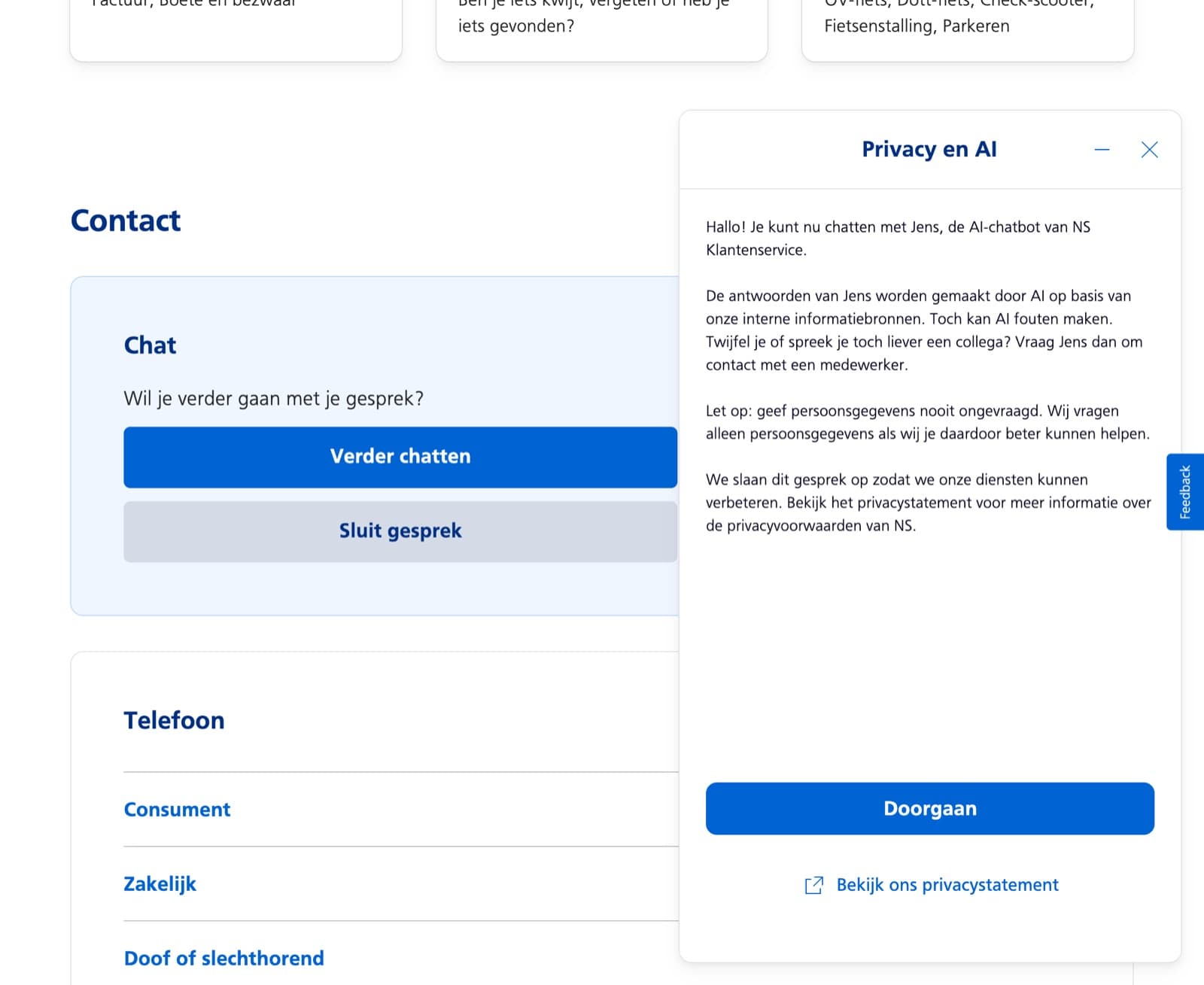
| NS (Dutch Railways) | A separate "Privacy and AI" screen opens before the chat: Jens is an AI chatbot, answers are generated by AI, AI can make mistakes, and you can ask for a human agent | Explicitly AI |
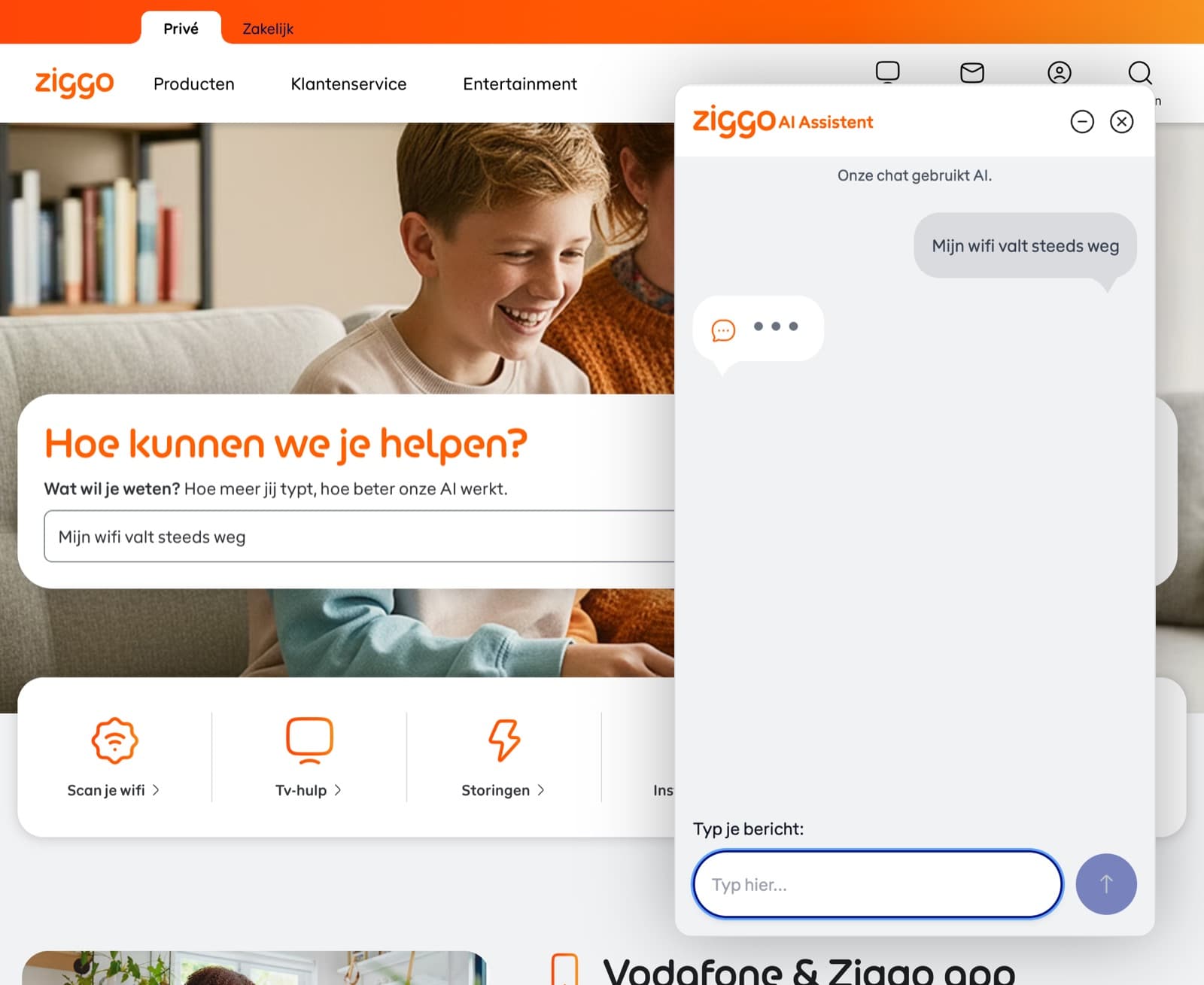
| Ziggo | The chat window is called "Ziggo AI Assistent" and the first line in the chat reads: "Our chat uses AI" | Explicitly AI |
| CZ | Every automatically generated answer in the Q&A function carries the label: "This answer was automatically generated with the help of AI. The information may be incomplete" | Explicit AI label per answer |
| Energy supplier | "Hello! I am the chatbot of ..." | Called a chatbot, the word AI never appears |
| Energy supplier | Chatbot with a human first name and a human-looking avatar, introduced as "our chatbot" | Called a chatbot, human name and avatar |
| Online retailer | "I am the digital assistant of ..." | Digital assistant, neither AI nor bot appears |
| Online retailer | "Digital service employee, always online", with a friendly first name | Service employee: a word that suggests a human |
| Bank | "You will get an instant answer from our Virtual Assistant", referred to as "she" | Virtual assistant, the word AI never appears |
| Two organisations | No publicly reachable chatbot found on the contact or customer service page | No public chat entry |
The three explicit examples deserve to be named, because they show that the solution is not complicated.
NS is the gold standard of this test. Before you type anything, a separate screen titled "Privacy and AI" opens. It states that Jens is an AI chatbot, that the answers are generated by AI based on internal information sources, that AI can make mistakes, and how to reach a human agent. Including a privacy explanation and a link to the privacy statement.
Ziggo takes the shortest route that works. The chat window is called "Ziggo AI Assistent" and the very first line of the conversation reads, in Dutch: "Onze chat gebruikt AI" (our chat uses AI). Four words, no room for misunderstanding.
CZ labels the answer rather than the channel. The Q&A function on its service page places under every generated answer: "This answer was automatically generated with the help of AI. The information may be incomplete. When in doubt, always check the source or contact us." Notably, CZ deliberately keeps its live chat with human agents and says so. This also touches on the obligations around AI-generated text in Article 50(2) and 50(4), covered in machine-readable marking of AI content.
Will "digital assistant" still be enough?
Half of the organisations we tested sit in what we call the grey zone. The bot is called a chatbot, digital assistant, virtual assistant or even digital service employee, but the word AI appears nowhere. Is that a problem from 2 August?
The honest answer: it depends on the context, and that is exactly why it is a risky place to sit. The defence is that a reasonably observant user who sees a chat window labelled chatbot or digital assistant understands that no human is answering. That argument weakens as the bot is dressed up more like a human: a first name, a face as an avatar, being referred to as "she", or a job title such as service employee that normally denotes a person. An organisation that deliberately humanises its bot while leaning on the context exception is asking a lot of that same context.
The supervisor is not the only risk either. Fines run through the national supervisory authority, a route we describe in enforcement and fines under Article 50, but the faster risk is reputational: customers who find out after 2 August that the friendly service employee was an AI system will mostly remember that nobody told them.
What should you arrange before 2 August?
The good news from this test: the gap between the grey zone and explicit disclosure is small. NS, Ziggo and CZ prove that a single design decision is enough. In practice it comes down to three steps.
Inventory every channel where AI interacts directly
Website chatbots, in-app assistants, WhatsApp bots, voicebots and automated email handling. Determine per channel whether an AI system generates the answers and who acts as provider and deployer for that system.
Make the AI notice explicit at the first interaction
A single line such as "Our chat uses AI" in the opening message already works. Better still is the NS model: also mention that AI can make mistakes and how the user reaches a human. Put the notice in the conversation itself, not tucked away on a terms page.
Document your choices per channel
If you rely on the context exception anywhere, record why the AI nature is obvious there to a reasonably observant user. Include disclosure requirements in contracts with chatbot vendors. The full task list is in our checklist for 2 August.
What happens next?
This field test will get a sequel. After 2 August 2026 we will repeat the test at the same ten organisations and publish what has changed. We will also extend the test to government chatbots, where the trust question weighs even heavier.
For the broader picture of all four transparency obligations, start with Article 50 in practice: all obligations at a glance.
Frequently asked questions
Sources
Newsletter
Every Tuesday, the AI Act week ahead in 5 minutes
A practical briefing on deadlines, new guidance and enforcement, so you know what matters this week. No spam and you can unsubscribe in one click.
Practical and short · No spam · One-click unsubscribe